Mudie - XI.
FOUNDATION OF THE ROYAL MILITARY COLLEGE.
|
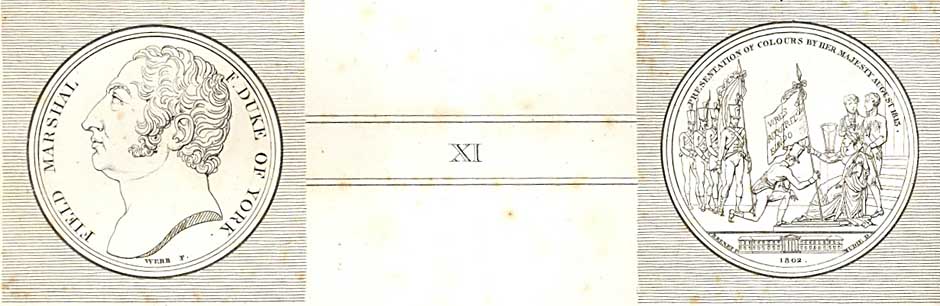
| THE services which the illustrious individual whose bust is on the obverse of this medal, has rendered to the British army, during the long series of years in which he has presided over its interests, and regulated its general discipline and management, are the theme of eulogy with everyone whom professional knowledge qualifies to judge upon such a subject. To his unabated exertions it is owing that the British army at this moment offers a model of perfection to every military nation. On various occasions, when discussions have arisen in Parliament connected with the army, the most unequivocal testimony has been borne to the distinguished merits of His Royal Highness. They, indeed, who remember what was the system pursued thirty years ago, and compare it with the one now in operation, must acknowledge that in no public department of the state have such signal improvements been introduced. Even during the period when His Royal Highness was persecuted by a despicable faction, who succeeded in raising a popular prejudice against him for a time, calumny itself could not deny that he was the ablest commander in chief this country ever possessed. |
| His impartial dispensation of promotion, and his anxious desire to reward the services of the meritorious officer, are acknowledged not only by the whole army, but by the country at large. That private feelings, whether of attachment or prejudice, may sometimes influence his decisions, is only to say, in other words, that he is man, and susceptible of human passions; but that he has ever allowed such feelings to acquire an undue ascendancy, or permitted his sense of duty to be palpably biassed by them, is disproved by the affection which the whole army bears towards him. The soldier regards him as his father; the subaltern officer as his patron; and the meritorious of all ranks, as their friend. |
| In discharging the multifarious duties of his office he is indefatigable, and the hours which he devotes to their laborious discharge, would be deemed a hardship by the youngest clerk at the Horse Guards. Every arrangement, the most minute, is submitted by the heads of departments for his sanction. The memorial of every officer, the petition of every soldier, engages his perusal or attention, nor are any suffered to pass unnoticed. |
| It would be injustice not to mention, that when the general peace was concluded in 1814, and our gallant soldiers returned to their native country, full of honours and renown, the House of Commons came to a deliberate vote of thanks to his Royal Highness, for the signal ability he had manifested in discharging the functions of his office. This vote is thus recorded in the journals of the House of Commons: |
| "6th July 1814. Resolved, that the Speaker do signify by letter to the Duke of York the thanks voted to the army, and that in addressing, his Royal Highness he do particularly express the high sense which the House entertains of his Royal Highness's long, unremitting, and effectual exertions for the improvement of the British army." |
| In addition to this solemn recognition of his Royal Highness's merits, it may be mentioned that the Duke of Wellington, when he received, in person, the thanks of both Houses of Parliament for his great services to Europe, ascribed no small part of the victories he had gained, to the high and efficient state of discipline of the troops which were sent out to him. It is no exaggerated eulogy, therefore, to say, that whenever that event shall happen, which will necessarily remove his Royal Highness from the post he now occupies, to fill the most august station in the empire, the change will prove a serious loss to the British army. |
| The noble institution, commemorated on the reverse of the present medal, is one of the many proofs which his Royal Highness has given, of his provident anxiety for the permanent good of the army. It was solely from his recommendation, and from the strong grounds of expediency which he laid before his late Majesty, that the Royal Military College at Sandhurst was established. |
| This College consists of two separate departments, called the Senior and the Junior. The former was founded in 1799, and the latter in 1802. Each department has its specific object. |
| The senior department was established for the purpose of instructing officers in the scientific parts of their duty, with a view to enable them more efficiently to discharge that duty when acting in the command of regiments. |
| The junior department is for the instruction of those who from early life are intended for the military profession. With this purpose is combined also, one of benevolence, for it is made to afford a provision for the sons of meritorious officers who have fallen, or have been disabled, in the service of their country, and the means of educating the sons of officers belonging to the regular service. |
| The national importance of such an establishment has been acknowledged by every one qualified to appreciate its value. Heretofore, it had been unwisely thought that every thing might be learned in the field that practice was the best school; and that theoretical generals were not very often the most efficient commanders in the day.of battle. Mere speculative knowledge, indeed, will qualify no man for any course of life: but it should be remembered, that the great leading characters of practice are mostly reducible to certain axioms. The art of war like every other art, is founded upon fixed principles, and without the knowledge of these no certain results can be calculated upon. It was surely an improvident system, therefore, which left the youthful soldier no other school but actual service, and which abandoned him to the necessity of acquiring experience too often through the medium of defeat and disgrace. This dangerous anomaly, however, is no longer our reproach. The military College at Sandhurst, and other establishments which have been either wholly organized or greatly improved by his Royal Highness the commander-in-chief, provide, at least, the means of acquiring the elements of military tactics. |
| Her late Majesty presented the colours (the ceremony of which is commemorated on the reverse of this medal) to the gentlemen cadets on the 12th of August 1813, as a token of the interest which she felt for the prosperity of the institution. |
|
| DESCRIPTION OF THE MEDAL. |
| Obverse. - Head of the Duke, witb the inscription round the face of the Medal-" FIELD MARSHAL F. DUKE OF YORK." |
Reverse. - The Queen presenting Colours to the Students of the Military College, at Sandhurst. On one of the Colours is the motto-" VIRES ACQUIRIT EUNDO." Behind are the College portico, and two attendants on her Majesty, one of them the Duke of York, the founder of the College. Above is this legend - " PRESENTATION OF COLOURS BY HER MAJESTY, AUGUST, 1813." On the exergue is the College, with the date of its foundation.
The head of the Duke has a beautiful firmness, delicacy of outline, and texture of flesh and hair. The execution is highly honourable to the English Artist, Mr. Webb. The figures on the reverse are marked with great neatness and precision. The design on this reverse is peculiarly appropriate to the general subject of the Medals, as this College is very justly acknowledged to be one of the best nurseries of that military excellence which has conducted the British arms to its present zenith of glory, under the able superintendance of the commander-in-chief. |
 |
|

