The Battle of Waterloo |
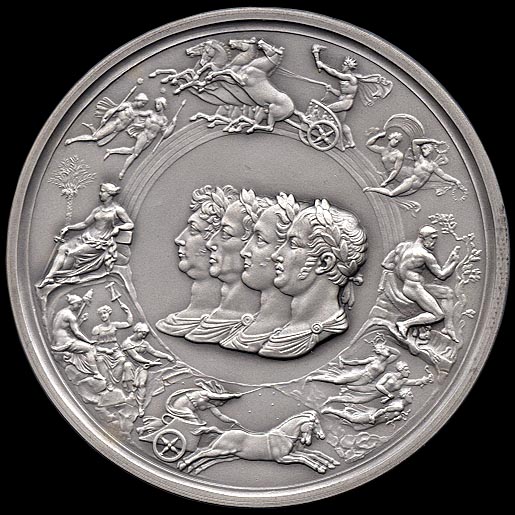 |
| Obv. |
Conjoined, laureate, draped busts of the four allied
sovereigns, the Prince Regent, Francis II of Austria, Alexander I
of Russia and Frederick William III of Prussia left. Around,
allegorical and mythological allusions to the Treaty of Peace which
resulted from the battle of Waterloo. Above, Apollo in a quadriga
restoring the day, the rainbow Zephyr and Iris follow the chariot
of the sun. Apollo is approaching the constellation of Gemini indicating
the month in which the battle took place. In front of the busts of
the four sovereigns is the figure of Themis, the protector of the
Just. Behind the heads, the figure of Hercules is seated upon a rock
above a cavern which suppresses the Furies who are no longer able
to leave the Cimmerian caverns. The Fates are shown below the figure
of Themis indicating that in future, human actions will be governed
by Justice alone. Night, the mother of the Fates receding into darkness
below. |
|
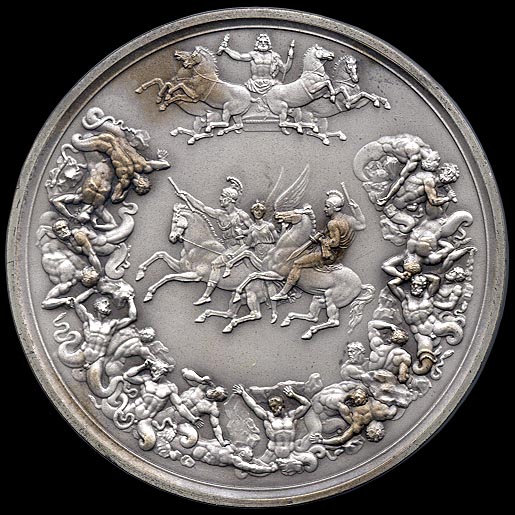 |
| Rev: |
Two equestrian figures in classical garb with the features of Wellington
and Blucher being guided to the conflict by Victory. Around the central
figures are many figures symbolising the battle of the giants, they
are being struck down by the thunder of Jupiter above. |
|
| Gutta percha; electrotype, 135 by B. Pistrucci. |
Gutta-percha RR; electrotype RR. |
| H.207. BM; RM. |
| |
| The night of the 16th/17th June saw the harried retreat of Wellington's
forces from Quatre Bras to the ridge at Waterloo which the Duke had noted
during his inspection of the countryside in the autumn of 1814. The French
forces were by this move forced into a frontal attack up the slopes towards
a line of fortified farms. The allies numbered some 63,000 men and 156 guns.
Late in the morning of the 18th, the French attacked the flanks of the allied
position, the Chateau of Hougoumont on the right and the fortified farm
of La Haye Sainte in the middle. The allies were outnumbered in both men
and guns, and in the face of a fierce artillery barrage, Wellington moved
his troops further back over the ridge. Marshal Ney advanced his troops
and fully expected to overrun the British lines but such was the fierceness
of the allied musket fire that virtually none of the enemy came within bayonet
distance. By six o'clock in the evening Ney's efforts were too late, since
the Prussians under Field-Marshal von Blucher had arrived and were harassing
the flanks of the French troops. After a final, ineffectual attack by Ney,
Wellington ordered his cavalry to attack and utterly routed the French;
the final pursuit was left to the Prussians who harried the fleeing French
throughout the night. By Blucher's timely appearance on the field of battle
Wellington's victory was the more complete and the Prussian Field-Marshal
became popular in England as a result of it. The City of London conferred
the freedom of the city on him and Oxford made him a D.C.L. |
| |
| In 1816 Pistrucci was invited to submit designs for this medal
which it was intended to strike in gold and give to the allied sovereigns,
their ministers and generals. In August 1819, Treasury authority was given
for the work to begin on the preparation of models. Unfortunately, due to
a disagreement between Pistrucci and the Master of the Mint over the office
of Chief Engraver, the work proceeded very slowly. Pistrucci felt that that
office which had been given to William Wyon (who had been performing those
duties for some time) should have gone to him. Pistrucci held the office
of Chief Medallist to the King for which he received a salary of �300 a
year plus another �50 for the instruction of a pupil, but nevertheless felt
disgruntled at not being given the more senior position. In 1832 Lord Auckland,
the then Master of the Mint, remonstrated with Pistrucci over the delay
in producing the medal and Pistrucci requested an assurance that if he completed
the medal his connections with the Mint would not be terminated. Lord Auckland
would not give such an undertaking and once more the work lapsed. To make
matters worse, the additional �50 that Pistrucci had been receiving as part
of his salary, was withdrawn. Further queries were raised with Pistrucci
in 1842, but again, arguments over the matter of salary delayed work. It
was not until August 1844 that agreement over the salary was reached whereby
it was raised from �300 to �350 a year and work upon the medal was resumed.
In 1849, the Master of the Mint was able to report that the dies were complete,
but by this time each of the four allied sovereigns depicted on the obverse
(and no doubt many of the other intended recipients of the medal) were dead.
|
| |
| Because of the difficulty of hardening dies of the size required
to strike the medal, Pistrucci made each die in two parts, an outer ring
which fitted around a central die of 71mm. diameter. Each of these was to
be hardened separately. Despite his suggestions, the dies were never hardened
and only gutta-percha impressions and electrotypes were made. These sometimes
occur joined together and the gutta-percha impressions are found in a black
japanned metal case. The wax model for the medal is in the Mint Museum in
Rome and the dies are in the Royal Mint Museum, London. |
| |
| N.B. Hocking (Royal Mint Catalogue, vol. II,
p. 208) states that the commission for the medal was given to Pistrucci,
no suitable designs having been received from members of the Royal
Academy. Graham Pollard has pointed out that the design by Flaxman was certainly
completed because the diarist Farington records having seen it on 15 August
1815. (See Royal Academy exhibition catalogue John Flaxman RA.
ed. D. Bindman, London, 1979, p. 135 and no.169.) Designs by West are published
in R. S. Kraemer, Drawings by Benjamin West, New York, 1975, nos.
101-103, and drawings by Stothard are in the Victoria and Albert Museum
(Dyce nos. 850-852). |
| |
| In 1967 Messrs John Pinches Ltd., produced a number of copies
of this medal in 22ct. gold, platinum and sterling silver. The size of these
copies is 64mm. and each of them is reputed to be either numbered or hallmarked.
The author has, however, seen an unmarked sterling silver example; there
may possibly be others. |
|
from British Historical Medals, Volume
1, p. 208-212
|
| |
| This is one of the 1967 copies. It has some unfortunate stains on the
reverse and is edge-marked 0428. |