½ Penny Token (D
& H 39 - Somersetshire, Bath) |
 |
 |
| Obverse - |
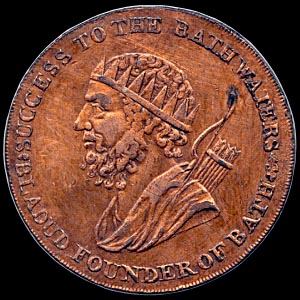
Male bust with a bushy beard and wearing an Eastern
crown; a bow and quiver of arrows slung across his shoulders. |
| Legend: |
SUCCESS TO THE BATH WATERS BLADUD FOUNDER OF BATH The
two halves of the legend are separated by an acorn on the left and
an oak leaf on the right.) |
|
| Reverse - |
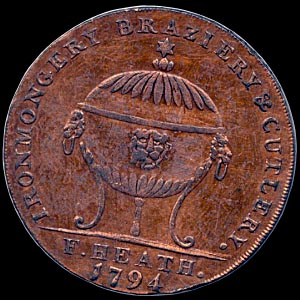
An eighteenth century tea-urn, surmounted by a hexagonal
star. |
| Legend: |
IRONMONGERY BRAZIERY & CUTLERY. with F. HEATH,
1794 in the exergue. |
|
| Edge: PAYABLE BY F. HEATH BATH - - - - - - -
- - |
| Diesinker, Wyon; manufacturer, Lutwyche. Five
cwts. struck. Common. |
| |
| Comments. Heath was an ironmonger, brazier and cutler in Bath,
and this was the first of several tokens issued by him. |
| |
| An eastern crown was granted to British subjects who
distinguished themselves in the East. It was a circlet of gold with, eight
rays, of which only five are usually seen in an engraving of it. It is difficult
to see why an Ancient British chieftain should be depicted in this manner
unless the intention was to show him as something strange and barbaric. |
| |
| Bladud was the eldest son of Lud Hudibras, king of Britain.
Educated at Athens, he returned home a leper, and was placed under restraint
to prevent the spread of infection. He escaped from his father's court in
disguise, and eventually reached Swanswick, three miles from Bath, where
he became a swineherd. One day he noticed that after the pigs wallowed in
the mire of the valley their skins became free of all sores. This led him
to discover a spring of water that cured him of his leprosy; he returned
to his father's court and later succeeded him. He then returned to the healing
water, cleansed the spring, erected baths, and built a splendid town to
commemorate his cure. |
| |
| The tea-urn shown on the reverse formed an indispensable
adjunct to the polite tea-table of the period. They were made in silver,
silver plate, or copper according to the affluence of the family. |
| Commercial Coins 1787-1804., pp. 150-151 |