| |
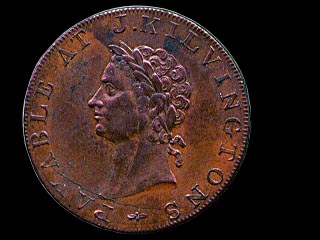
| Comments. No locality is given on this token, but Pye states that
it circulated in the Metropolis. The issuer was probably John Kilvington,
a grocer and tea-dealer at No. 153 Drury Lane, London. |
| |
| The identity of the bust on the obverse is uncertain
but it may have been intended for the Queen's father, the Duke of Brunswick. |
| |
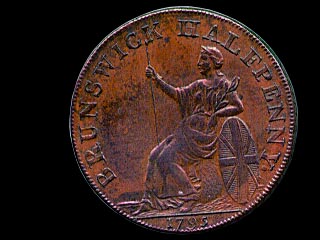
| The representation of Britannia is finer than most.
The ancient city of Athens was personified as Athena, the patron goddess,
who appeared on many Greek coins, seated and holding Nike, the symbol of
victory, on her outstretched hand. The Romans copied this concept, and Roma
holding a winged victory represented the Imperial City. When Britain was
conquered Roman coins were struck showing a personification of the colony
as a weeping woman with a broken spear sitting on a rock. The As of Antoninus
Pius is the commonest of these Roman "Britannias." |
| |
| When Charles II was persuaded to issue copper coins,
Pepys states that the reigning court beauty and king's mistress, the Duchess
of Richmond, posed for the artist; and the halfpenny and farthing of 1672
bear her likeness as Britannia. In succeeding reigns the graceful and flowing
lines of the figure became stiff and resembled the Roman prototype. |
| |
| The figure on this token is more natural than that on the
regal coinage of the time. Note that she bears a simple spear instead of
a trident. Kücher followed this softening trend with his Britannia
on the regal 1797 and 1799 issues, but gradually over the years Britannia
has become more and more lifeless, until the current penny (1963) presents
her as a stiff inanimate object in a helmet. |
| Commercial Coins 1787-1804., pp. 108-109 |