| |
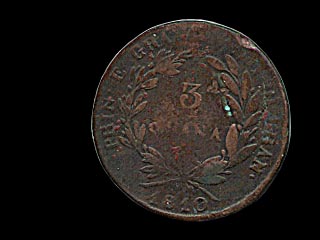
| What shows up on the obverse as a vertical white line is a planchet flaw.
The legend is hard to read well. Where it isn't worn away it's encrusted with
a dark soil of some sort. What's missing is within the parenthesis above. |
| |
| Strangely enough Murat was a Grand Admiral of the French fleet, a fact
that is commemorated in the legend. In the Répertoire des Monnaies
Napoléonides (1971, p. 324) there are two types described. This
has the type 2 reverse described in the book. The main difference in these
two types is that the 1st type reverse has a legend that is spelled out
and the type 2 legend is abbreviated. The mintage is unknown. |
| |
| From Répertoire des Monnaies Napoléonides,
pg.324: |
| 3 GRANA |
| Métal: |
Cuivre |
Poids: |
18,71 g. |
| ø: |
33 à 35 mm |
|
|
| |
| D / |
Tête nue à gauche. |
| |
GIOACCHINO NAP. RE DELLE DUE SIC. |
| R / |
Valeur et date entre une branche d'olivier et
une tige de siegle. |
| |
PRINCIPE E GRAND' AMMIRAGLIO DI FRANCIA - étoile
ou rosette. |
| |
2e type: Identique
sauf AMMI au lieu de AMMIRAGLIO et la date 1810 à l'exergue
au lieu d'être dans le champ sous la valeur. |
| |
| Tranche ornée en relief. |
|
| And in part: |
| 1810*: |
*) Ces pièces se trouvent
difficilement en bel état de conservation. |
|
|
| From Monete Italiane dall'invasione Napoleonica,
pg. 328-329: (50-f(?)) |
| Métal: |
R |
Peso: |
18,71 g. |
| ø: |
33/35 mm |
|
|
| |
| Dritto / |
GIOACCHINO NAP * RE DELLE DUE SIC * testa nuda
a s. |
| Rovescio / |
PRIN * E GRAND' AMMI * DI FRAN * |
| |
nel giro 3 // GRANA // nel campo, tra rami di
mirto e di lauro; sotto. 1810 |
| |
| Contorno / |
serpentina in rilievo |
|
|
|
| And in part: |
| 1810: |
Di queste monete esistono altre
varianti, particolarmente nella figura dello stelo di grano,
nel numero delle bratte, e nella grandezza delle lettere del
valore. |
|
|